REQUIEM // 37
Operator's Manual
Installation & Activation
REQUIEM // 37 ships as a single macOS installer containing all three formats. Double-click REQUIEM-37-v1.0.0-macOS-Installer.pkg, follow the steps, and enter your Mac password when asked. The installer places:
- Audio Unit (Logic Pro, GarageBand, MainStage):
/Library/Audio/Plug-Ins/Components/REQUIEM-37.component - VST3 (Ableton Live, Reaper, Cubase, FL Studio, Bitwig):
/Library/Audio/Plug-Ins/VST3/REQUIEM-37.vst3 - Standalone instrument:
/Applications/REQUIEM-37.app
Restart your DAW after installing so it rescans its plug-in folders. In Logic Pro the instrument appears under AU Instruments → FLARES Instruments → REQUIEM-37.
Activating your license
- Open REQUIEM // 37 (any format).
- Click the requiem // 37 brand plaque in the top-left corner of the interface.
- Enter your license key — the format is
RQ37-XXXX-XXXX-XXXX— and press ACTIVATE.
Activation is fully offline: no account, no iLok, no server check, no background daemon. Your key is stored at ~/Music/FLARES Instruments/REQUIEM-37/license.key and covers all of your personal studio Macs. Keep your key with your records; copying that file to another of your machines activates it there too.
Quick Start — First Dread in Sixty Seconds
- Load a patch. Use the preset selector in the header bar, or the < / > arrows to step through the 50 factory patches. Start with 01 // SERPENT DEATH-BEAT.
- Play one low note. REQUIEM // 37 is monophonic by design — it pours everything into a single voice. C1–C2 is where it lives. Hold the note; the engine's drift, feedback, and space do the rest.
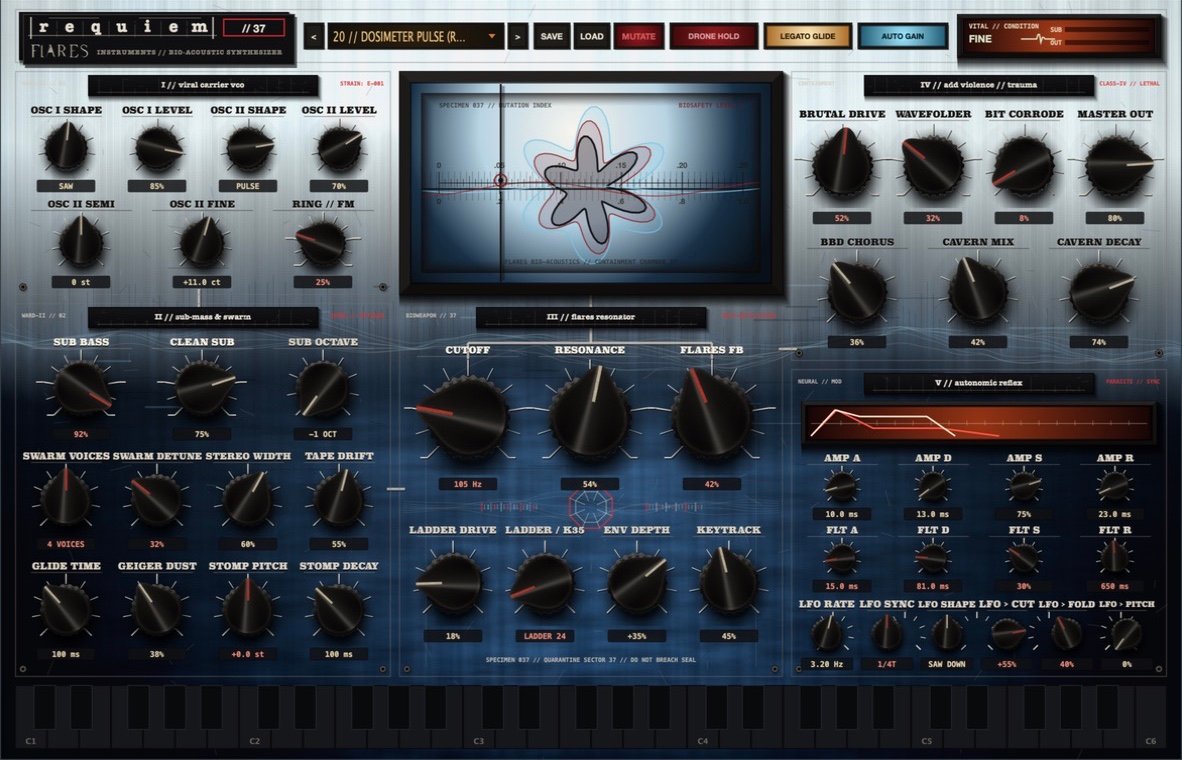
- Grab the Specimen Chamber. Click and drag inside the central display: left–right sweeps the filter cutoff, up–down pushes resonance. This is the fastest way to perform the instrument.
- Engage DRONE HOLD. The red switch in the header latches an endless drone with no hands on the keyboard — ideal for sound design and resampling.
- Hit MUTATE. Each press organically nudges oscillator shapes, filter, feedback, and space within musically safe limits. When a mutation lands somewhere good, save it: SAVE writes a
.rq37patch file you can reload anywhere.
Signal Flow — Why the Low End Survives
The architecture answers one question: how do you destroy a sound without destroying its weight? The path is:
DUAL MORPHING VCOs + SUB + NOISE → FLARES RESONATOR (ZDF ladder / K-35) → 115 Hz CROSSOVER SPLIT → [above 115 Hz: 2× oversampled wavefolder → tube clipper → bit corroder] + [below 115 Hz: gentle warmth only] + [CLEAN SUB direct path] → BBD CHORUS → CAVERN REVERB → AUTO-GAIN & SAFETY LIMITER
- The 115 Hz crossover splits the filter output. Everything above 115 Hz is fed to the destruction stage; everything below bypasses it with only mild tube warmth. Your fundamental stays mono, phase-coherent, and chest-rattling no matter how hard you push the wavefolder.
- The CLEAN SUB direct path goes further: a pure sine tap of the sub-oscillator that skips the filter's distortion entirely (see Panel II).
- The chorus and reverb are high-passed (150 Hz and 180 Hz) so the stereo effects never smear the low end — sub stays centered, space lives above it.
- Auto-gain (header switch) compensates level as you add drive, fold, and feedback, and a transparent peak limiter catches anything that still tries to clip.
Header Controls
| Control | Type | Function |
|---|---|---|
| PRESET SELECTOR | menu | All 50 factory patches, grouped by the six categories. The < / > arrows step through them in order. |
| SAVE | button | Saves the complete current state as a .rq37 patch file (XML). Default folder: ~/Music/FLARES Instruments/REQUIEM-37/Presets. |
| LOAD | button | Loads any .rq37 patch file. |
| MUTATE | button | Randomly nudges 18 key parameters (oscillator shapes, detune, filter, feedback, destruction, space, LFO) within curated safe ranges. Repeated presses keep evolving the patch. |
| DRONE HOLD | latch | Latches the voice on indefinitely with no MIDI input (defaults to C1 if no note has been played). Flip off to release. |
| LEGATO GLIDE | latch | When on, overlapping notes glide without retriggering the envelopes; detached notes retrigger. When off, every note retriggers. |
| AUTO GAIN | latch | Enables gain compensation for drive/fold/feedback plus the output safety limiter. Disable only when you want to stage-gain into another processor yourself. |
| VITAL // CONDITION | meter | Output telemetry: SUB shows low-frequency energy, OUT shows peak level, and the condition word reads FINE → CAUTION → DANGER as intensity rises. DANGER is not an error — it is an aesthetic judgment. |
Panel I — Viral Carrier VCO
Two continuously morphing oscillators with cross-FM and ring modulation. There are no waveform switches — each SHAPE knob sweeps smoothly through the territory:
SINE → TRI-SIN → SAW → PULSE (narrowing) → FOLDED
| Control | Range | Function |
|---|---|---|
| OSC I SHAPE | 0–100% | Morphs Oscillator I through the waveform territory above. Saw and pulse regions are PolyBLEP anti-aliased. |
| OSC I LEVEL | 0–100% | Oscillator I level into the mix. |
| OSC II SHAPE / LEVEL | 0–100% | Same morphing engine for Oscillator II. |
| OSC II SEMI | ±24 st | Oscillator II coarse tune in semitones. Try +7 (power fifth), +6 (tritone dread), −12 (octave weight). |
| OSC II FINE | ±100 ct | Fine detune in cents — a few cents of offset gives analog movement between the two oscillators. |
| RING // FM | 0–100% | Oscillator I modulates Oscillator II's frequency (cross-FM) while a ring-modulated product is blended in. Low settings add growl; high settings turn metallic and clangorous. |
Panel II — Sub-Mass & Swarm
The subharmonic section
| Control | Range | Function |
|---|---|---|
| SUB BASS | 0–100% | Level of the dedicated sub-oscillator (78% sine / 22% anti-aliased square), always phase-coherent and mono. |
| SUB OCTAVE | −1 / −2 | Sub plays one or two octaves below the note. |
| CLEAN SUB | 0–100% | The low-end insurance policy: blends in a pure low-passed sine tap of the sub that bypasses the filter's drive entirely, and proportionally pulls the sub out of the filter path. At high settings your fundamental is untouchable. |
| GEIGER DUST | 0–100% | Pink-noise rumble plus stochastic crackle impulses — vinyl dust, Geiger clicks, lab static. |
| STOMP PITCH | ±24 st | A one-shot pitch envelope fired on each (non-legato) note: the pitch starts offset by this amount and slams to the played note. Positive = downward impact ("hydraulic stomp"), negative = upward suction riser. |
| STOMP DECAY | 10–800 ms | How fast the stomp envelope lands. Short = transient knock; long = audible dive. |
The swarm
| Control | Range | Function |
|---|---|---|
| SWARM VOICES | 1–7 | Unison voice count for the two main oscillators. 1 = MONO purity; 7 = full industrial swarm. (The sub always stays a single centered voice.) |
| SWARM DETUNE | 0–100% | Spread of per-voice detuning across the swarm. |
| STEREO WIDTH | 0–100% | Pans the swarm voices across the stereo field with equal-power panning. |
| TAPE DRIFT | 0–100% | Two instabilities at once: slow tape wow (0.58 Hz) with faster flutter (6.3 Hz), plus independent per-voice thermal pitch drift (an Ornstein–Uhlenbeck random walk). This is the "worn cassette" in the sound. |
| GLIDE TIME | 0–800 ms | Portamento between notes. With LEGATO GLIDE on, only connected notes glide. |
Panel III — FLARES Resonator
The heart of the instrument: a non-linear Zero-Delay Feedback filter with three morphable topologies and a pre-filter feedback loop.
| Control | Range | Function |
|---|---|---|
| CUTOFF | 20 Hz–18 kHz | Filter cutoff. Also driven by the filter envelope, LFO, key tracking, and the Specimen Chamber's X axis. |
| RESONANCE | 0–100% | Resonance into self-oscillation territory near the top. With drive, the filter screams and whistles like overdriven hardware. |
| FLARES FB | 0–100% | The signature circuit: the filter's own output is fed back into its input through a saturating stage — the digital equivalent of patching a synth's output back into its external input. Low amounts thicken; high amounts push the filter into unstable, howling self-oscillation that fights the played note. |
| LADDER DRIVE | 0–100% | Asymmetric tube-style saturation at the filter input — second-harmonic warmth into grit. |
| LADDER / K35 | morph | Continuously morphs the topology: LADDER 24 (fat 24 dB/oct transistor ladder) → K-35 SCREAM (aggressive resonant peak voicing) → BP GRIT (hollow, vocal bandpass). |
| ENV DEPTH | ±100% | Filter envelope amount, bipolar — negative values close the filter on attack. Scaled by note velocity. |
| KEYTRACK | 0–100% | How much the cutoff follows the played pitch. |
Panel IV — Destruction & Cavern
Everything here operates above the 115 Hz crossover only — crank it without fear for your low end. The non-linear stages run 2× oversampled with anti-alias filtering.
| Control | Range | Function |
|---|---|---|
| BRUTAL DRIVE | 0–100% | Asymmetric tube/diode clipper — from warm push to shredded industrial saturation. |
| WAVEFOLDER | 0–100% | West-Coast sine folding. Harmonics bloom and fold back on themselves; magnificent on simple waves, violent on the swarm. |
| BIT CORRODE | 0–100% | Combined sample-rate decimator and bit-depth reducer — digital rust, 1994-sampler grit. |
| MASTER OUT | 0–100% | Final output level. |
| BBD CHORUS | 0–100% | Dark bucket-brigade-voiced stereo chorus, high-passed at 150 Hz so width never touches the sub. |
| CAVERN MIX | 0–100% | Send into the cavern reverb — a dark, modulated comb/all-pass tank, high-passed at 180 Hz, sample-rate invariant (the room is the same size at 44.1 kHz and 192 kHz). |
| CAVERN DECAY | 0–100% | Tail length, up to roughly ten seconds of abandoned-bunker wash at maximum. |
Panel V — Envelopes & LFO
Envelopes
Two analog-style exponential ADSRs: AMP A/D/S/R shapes loudness; FLT A/D/S/R drives the filter via ENV DEPTH. Attacks run 1 ms–3 s; decay and release 10 ms–4 s. The red/white display above the knobs previews both curves (red = filter, white = amp).
The LFO
| Control | Range | Function |
|---|---|---|
| LFO RATE | 0.05–18 Hz | Free-running speed. Ignored while LFO SYNC is on a division. |
| LFO SYNC | FREE … 1/32 | Host-tempo sync. FREE uses the RATE knob; any division locks to your DAW tempo: 1/1, 1/2, 1/2., 1/4, 1/4., 1/4T, 1/8, 1/8., 1/8T, 1/16, 1/16T, 1/32 (dotted = ·, triplet = T). While the transport runs, the LFO is phase-locked to the song position — it lands on the grid identically on every playback and bounce. In the standalone (no transport) a division runs at 120 BPM. |
| LFO SHAPE | 5 shapes | SINE, TRIANGLE, SAW DOWN (ramp), S&H (stepped random), DRIFT (smoothed random). S&H and DRIFT step at each cycle — on a synced division they step on the beat grid. |
| LFO > CUT | ±100% | LFO to filter cutoff, bipolar, up to ±3.5 octaves. The engine of every pulse patch. |
| LFO > FOLD | 0–100% | LFO morphs the oscillator shapes toward/away from the folded zone — breathing timbre. |
| LFO > PITCH | 0–100% | LFO to pitch, up to ±2 semitones — subtle vibrato through siren territory. |
The Specimen Chamber
The central display is both instrument telemetry and a performance surface. The ferrofluid specimen breathes with the sub energy, bristles with resonance and feedback, and traces the live output waveform across the glass.
- Click and drag anywhere inside the chamber: horizontal position sets CUTOFF, vertical position sets RESONANCE. Both gestures write host automation when recorded in a DAW.
- The dark vertical needle tracks the current cutoff; the small crimson reticle marks the exact cutoff/resonance coordinate.
MIDI & Expression
| Source | Message | Effect |
|---|---|---|
| Keyboard | notes | Monophonic, last-note priority with a held-note stack — release the top note and the previous one resumes. Velocity scales the filter envelope's bite. |
| Mod Wheel | CC 1 | The expression macro: simultaneously opens the filter (up to +1.5 octaves), adds wavefold, adds FM, and pushes FLARES feedback. Riding the wheel is performing the instrument's intensity. |
| Aftertouch | channel pressure | Same macro as the mod wheel (whichever is greater wins) — lean into a held note to make it snarl. |
| Pitch Wheel | pitch bend | ±2 semitones. |
| Sustain Pedal | CC 64 | Holds the voice after note-off; releasing the pedal with no keys held releases the envelope. |
The on-screen keybed (C1–C6) plays the engine with the mouse and mirrors incoming MIDI.
The Factory Library
Fifty patches across six categories. They are starting points — MUTATE and the Specimen Chamber are how they become yours.
| Category | Count | Character |
|---|---|---|
| BASS // DEATH-BEAT | — | Slow, crushed, chest-first sub bass: trip-hop doom, worn-tape monoliths, feedback-laced low end. |
| DRONE // BIO-HORROR | — | Evolving dread beds: reactor hum, haunted corridors, frozen tanks, cathedral ash. Built for DRONE HOLD. |
| INDUSTRIAL // SWARM | — | Detuned unison aggression: chainsaw walls, broken transistors, diesel engines. |
| SCORE // PULSE | — | Rhythmic tension for picture: LFO pulses, telemetry S&H, suspense swells. Prime tempo-sync material. |
| IMPACT // SUB-DROP | — | One-shot seismic hits and risers built on the STOMP envelope. |
| LEAD // SCREAMER | — | Self-oscillating K-35 leads, theremin wails, bowed-metal solo voices. |
User patches are plain-text XML .rq37 files — version them, share them, or edit them by hand if you dare. Loading a patch replaces the entire engine state.
Custom Skins
The entire faceplate is a set of 2× retina PNGs loaded live from ~/Music/FLARES Instruments/REQUIEM-37/Skin/. The plugin watches that folder and hot-reloads within a second of any file changing — edit while the instrument is open and watch it change.
backdrop_2x.png— the active 2360×1520 chassis. Four alternates ship in the folder (gunmetal, lead ash, pewter, putty): copy one overbackdrop_2x.pngto switch.knob_*_base.png/knob_*_cap_*.png— the layered knob sprites (stationary base + rotating cap, bone and crimson variants).biocore_glass_2x.png— the Specimen Chamber's glass overlay.TEMPLATE_2360x1520.png— a pixel-exact layout blueprint for building your own skin.
Delete or rename the folder's files and the plugin falls back to its built-in skin. No restart required in either direction.
Specifications
| Item | Detail | |
|---|---|---|
| Formats | Audio Unit v2 (aumu Rq37 Flrs), VST3, Standalone app | |
| System | macOS 11.0 Big Sur or later; Universal 2 binary (Apple Silicon native + Intel) | |
| Sample rates | 44.1, 48, 88.2, 96, 192 kHz — DSP is sample-rate invariant | |
| Voices | Monophonic/legato engine; up to 7 unison swarm voices + independent sub oscillator | |
| Validation | Apple auval pass; pluginval pass at maximum strictness; 232-check automated DSP audit | |
| License | Perpetual, offline serial key; all personal studio Macs; free 1.x updates |
Troubleshooting
- The plugin doesn't appear in my DAW. Restart the DAW after installing. In Logic, run a plug-in rescan (Logic Pro → Settings → Plug-in Manager). Confirm the files exist at the paths in Section 01.
- No sound. REQUIEM // 37 needs MIDI input — play a note, click the on-screen keybed, or engage DRONE HOLD. In the standalone, check Options → Audio/MIDI Settings for the correct output device.
- The sound cuts off strangely between notes. That's monophonic legato behavior — see LEGATO GLIDE in Section 04 to choose between gliding and retriggering.
- It screams on its own with no note held. FLARES FB past ~70% with high resonance self-oscillates by design. Back off either control, or enjoy it.
- The low end feels thin with heavy distortion. Raise CLEAN SUB — it is specifically there to restore an untouched fundamental under any amount of destruction.
- Synced LFO drifts in the standalone. The standalone has no transport, so divisions run at a fixed 120 BPM; grid-locking requires a host DAW.
- My license key isn't accepted. Keys are exactly
RQ37-XXXX-XXXX-XXXX(19 characters, letters A–F and digits). Copy-paste it whole from your receipt. Still stuck? Write to support@flaresinstruments.com with your order number.